Механизмы
Содержание:
Basic Principles of Redstone
Redstone is all about ‘power’ &emdash; you can think of it as being a bit like electricity. Redstone power comes from a power source, and can be transmitted to devices which will then do something in response.
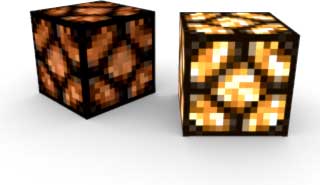
Redstone lamps are used in many of the examples on this page to show which blocks are switched on.
- Power sources
- These are the things that provide redstone power: they include switches, redstone torches and the like.
- Powered blocks
- Most types of blocks can become powered. This can happen when the blocks contain a power source, or when they are attached to a power source. For example, if you push a button, two blocks become powered: the block containing the button, and the block the button is attached to.
- Switching blocks ON
- Once a block is powered, it can switch on the blocks directly next to it. The blocks that are switched on are not themselves «powered» (i.e. they will not transmit power to their neighbours), but if they are devices, they will be activated.
- Devices
- This is a term we use to describe anything that does something when switched on by redstone: for example, a light will light up, a door will open, or TNT will blow up.
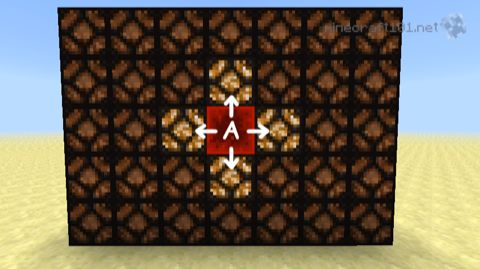
A block of redstone (A) is always powered; it switches on the blocks that are directly next to it.
When a lever is switched on, both its own block (A) and the one it is attached to (B) are powered. Both of these powered blocks switch on the blocks next to them.
Translating real music[]
When making redstone music in vanilla Minecraft, it’s very helpful to know how you can translate sheet music you find online into an actual note block circuit. The main two factors of music are rhythm and pitch. Rhythm is determined by how many repeaters you put before/after a note block, and how many ticks you set them to, and pitch is determined by how many times you right click a note block. Once you know how rhythm and pitches relate to ticks and note blocks, you can make an infinite number of songs.
Pitch
Main article:
Pitch is one of the most important factors of music. Here is a table of how all notes in music that are able to be played on Minecraft can be simulated with note blocks. The table shows how many times to press the noteblock to get the desired pitch.
| Pitch | String bass | Bell | Flute | Chime | Guitar | Xylophone | Iron xylophone | Cow bell | Didgeridoo | «Bit» | Banjo | «Pling» | Harp/piano |
|---|---|---|---|---|---|---|---|---|---|---|---|---|---|
| F♯1/G♭1 | |||||||||||||
| G1 | 1 | 1 | |||||||||||
| G♯1/A♭1 | 2 | 2 | |||||||||||
| A1 | 3 | 3 | |||||||||||
| A♯1/B♭1 | 4 | 4 | |||||||||||
| B1 | 5 | 5 | |||||||||||
| C2 (low C) | 6 | 6 | |||||||||||
| C♯2/D♭2 | 7 | 7 | |||||||||||
| D2 | 8 | 8 | |||||||||||
| D♯2/E♭2 | 9 | 9 | |||||||||||
| E2 | 10 | 10 | |||||||||||
| F2 | 11 | 11 | |||||||||||
| F♯2/G♭2 | 12 | 12 | |||||||||||
| G2 | 13 | 1 | 13 | ||||||||||
| G♯2/A♭2 | 14 | 2 | 14 | ||||||||||
| A2 | 15 | 3 | 15 | ||||||||||
| A♯2/B♭2 | 16 | 4 | 16 | ||||||||||
| B2 | 17 | 5 | 17 | ||||||||||
| C3 | 18 | 6 | 18 | ||||||||||
| C♯3/D♭3 | 19 | 7 | 19 | ||||||||||
| D3 | 20 | 8 | 20 | ||||||||||
| D♯3/E♭3 | 21 | 9 | 21 | ||||||||||
| E3 | 22 | 10 | 22 | ||||||||||
| F3 | 23 | 11 | 23 | ||||||||||
| F♯3/G♭3 | 24 | 12 | 24 | ||||||||||
| G3 | 13 | 1 | 1 | 1 | 1 | 1 | |||||||
| G♯3/A♭3 | 14 | 2 | 2 | 2 | 2 | 2 | |||||||
| A3 | 15 | 3 | 3 | 3 | 3 | 3 | |||||||
| A♯3/B♭3 | 16 | 4 | 4 | 4 | 4 | 4 | |||||||
| B3 | 17 | 5 | 5 | 5 | 5 | 5 | |||||||
| C4 (middle C) | 18 | 6 | 6 | 6 | 6 | 6 | |||||||
| C♯4/D♭4 | 19 | 7 | 7 | 7 | 7 | 7 | |||||||
| D4 | 20 | 8 | 8 | 8 | 8 | 8 | |||||||
| D♯4/E♭4 | 21 | 9 | 9 | 9 | 9 | 9 | |||||||
| E4 | 22 | 10 | 10 | 10 | 10 | 10 | |||||||
| F4 | 23 | 11 | 11 | 11 | 11 | 11 | |||||||
| F♯4/G♭4 | 24 | 12 | 12 | 12 | 12 | 12 | |||||||
| G4 | 1 | 13 | 1 | 13 | 13 | 13 | 13 | ||||||
| G♯4/A♭4 | 2 | 14 | 2 | 14 | 14 | 14 | 14 | ||||||
| A4 | 3 | 15 | 3 | 15 | 15 | 15 | 15 | ||||||
| A♯4/B♭4 | 4 | 16 | 4 | 16 | 16 | 16 | 16 | ||||||
| B4 | 5 | 17 | 5 | 17 | 17 | 17 | 17 | ||||||
| C5 | 6 | 18 | 6 | 18 | 18 | 18 | 18 | ||||||
| C♯5/D♭5 | 7 | 19 | 7 | 19 | 19 | 19 | 19 | ||||||
| D5 | 8 | 20 | 8 | 20 | 20 | 20 | 20 | ||||||
| D♯5/E♭5 | 9 | 21 | 9 | 21 | 21 | 21 | 21 | ||||||
| E5 | 10 | 22 | 10 | 22 | 22 | 22 | 22 | ||||||
| F5 | 11 | 23 | 11 | 23 | 23 | 23 | 23 | ||||||
| F♯5/G♭5 | 12 | 24 | 12 | 24 | 24 | 24 | 24 | ||||||
| G5 | 1 | 13 | 1 | 1 | 13 | ||||||||
| G♯5/A♭5 | 2 | 14 | 2 | 2 | 14 | ||||||||
| A5 | 3 | 15 | 3 | 3 | 15 | ||||||||
| A♯5/B♭5 | 4 | 16 | 4 | 4 | 16 | ||||||||
| B5 | 5 | 17 | 5 | 5 | 17 | ||||||||
| C6 (high C) | 6 | 18 | 6 | 6 | 18 | ||||||||
| C♯6/D♭6 | 7 | 19 | 7 | 7 | 19 | ||||||||
| D6 | 8 | 20 | 8 | 8 | 20 | ||||||||
| D♯6/E♭6 | 9 | 21 | 9 | 9 | 21 | ||||||||
| E6 | 10 | 22 | 10 | 10 | 22 | ||||||||
| F6 | 11 | 23 | 11 | 11 | 23 | ||||||||
| F♯6/G♭6 | 12 | 24 | 12 | 12 | 24 | ||||||||
| G6 | 13 | 13 | 13 | ||||||||||
| G♯6/A♭6 | 14 | 14 | 14 | ||||||||||
| A6 | 15 | 15 | 15 | ||||||||||
| A♯6/B♭6 | 16 | 16 | 16 | ||||||||||
| B6 | 17 | 17 | 17 | ||||||||||
| C7 | 18 | 18 | 18 | ||||||||||
| C♯7/D♭7 | 19 | 19 | 19 | ||||||||||
| D7 | 20 | 20 | 20 | ||||||||||
| D♯7/E♭7 | 21 | 21 | 21 | ||||||||||
| E7 | 22 | 22 | 22 | ||||||||||
| F7 | 23 | 23 | 23 | ||||||||||
| F♯7/G♭7 | 24 | 24 | 24 |
Rhythm
Rhythm is another important factor of music, which is basically how long a note is held for. The next table shows how many redstone ticks, using repeaters, must go after a note block, depending on the tempo of the music, and what kind of rhythm the note is. Remember; the maximum number of ticks for one repeater is 4, so if you need more than 4 ticks, you need more than one repeater. Also, the numbers you see on top is the tempo of the music, which is how many beats there are in a minute.
| 50 | 60 | 75 | 100 | 150 | |
|---|---|---|---|---|---|
| Sixteenth note/rest | 3 ticks | (No exact match) | 2 ticks | (No exact match) | 1 tick |
| Triplet note/rest | 4 ticks | (No exact match) | (No exact match) | 2 ticks | (No exact match) |
| Eighth note/rest | 6 ticks | 5 ticks | 4 ticks | 3 ticks | 2 ticks |
| Quarter note/rest | 12 ticks | 10 ticks | 8 ticks | 6 ticks | 4 ticks |
| Half note/rest | 24 ticks | 20 ticks | 16 ticks | 12 ticks | 8 ticks |
| Dotted half note/rest | 36 ticks | 30 ticks | 24 ticks | 18 ticks | 12 ticks |
| Whole note/rest | 48 ticks | 40 ticks | 32 ticks | 24 ticks | 16 ticks |
If you must have your song in a tempo where triplets have no exact match, you can substitute for 2 sixteenth notes followed by an eighth note, which sound similar to triplets at faster tempos.
Sounds
Main article:
Different sounds can be made on note blocks by putting different types of blocks under note blocks. Here is a list of what block(s) you need to put under a note block to make it have a specific sound.
- Bass = (any type), mushroom (block), daylight sensor, banner, sign, note block
- Bass drum = (any type), bricks, netherrack, magma block, purpur block, concrete, nether quartz
- Bell = Block of gold
- Chime = Packed ice
- Clicks and sticks = Glass (any type), sea lantern
- Flute = Clay block
- Guitar = Wool
- Snare drum = Sand, gravel, concrete powder
- Xylophone = Bone block
- Piano (harp) = Any other block (e.g. dirt, piston, rail, leaves)
- Iron Xylophone = Block of Iron
- Cowbell = Soul Sand
- Didgeridoo = Pumpkin
- Bit = Block of Emerald
- Banjo = Hay Bale
- Pling = Glowstone
Что делают компоненты Redstone в Minecraft?
Это основные компоненты красного камня, которые вы найдете в игре, и краткое описание того, что каждый из них делает.
Источники энергии Redstone
Источники питания — это блоки, которые автоматически излучают сигнал мощности красного камня . Некоторые из них сильнее других, и со многими из них нужно взаимодействовать, чтобы сигнал был включен.
Факел из красного камня
Самый простой источник энергии , они предоставят уровень мощности 15 любым блокам, с которыми они соприкасаются.
Размещение факела из красного камня очень важно. Факел не будет приводить в действие блок, к которому он непосредственно прикреплен , но будет приводить в действие кучу блоков вокруг него
Его сила сигнала с пылью красного камня составляет 15 блоков до того, как сигнал умрет.
Блок красного камня
Полный блок из красного камня даст сигнал мощностью 15 блоков при подключении к пыли из красного камня.
Он также активирует любые устройства и блоки, которые непосредственно примыкают к одной из его шести сторон.
Кнопка
Кнопки выдают одиночный импульс сигнала красного камня, когда они прикреплены к проводке из красного камня.
Сигнал проходит 15 блоков и активирует любые устройства на своем пути. Кнопки также приводят в действие блок, к которому они прикреплены , а также несколько блоков вокруг них.
Поскольку кнопка считается блоком , блоки, расположенные напротив нее, сверху или снизу, также будут получать питание.
Рычаг
Рычаги имеют тот же диапазон, что и кнопки, при использовании в проводке, то есть 15 блоков. Они издают непрерывный сигнал при однократном нажатии на рычаг и могут быть выключены при повторном нажатии.
Рычаг приводит в действие блоки вокруг него так же, как и кнопка, поэтому любой блок, к которому он прикреплен, будет получать питание, так же как и все вокруг него.
Пластины давления
Обычные деревянные и каменные нажимные пластины , когда игрок наступает на них, посылают сигнал 15 блоков. Каменные будут обнаруживать только пассивных мобов, враждебных мобов и игроков , но не предметы. Они также активируют блоки рядом с ними, а также непосредственно под ними.
У утяжеленных нажимных пластин будет более сильный сигнал, чем больше на них набито сущностей , будь то мобы или предметы, брошенные на землю. Для активации тяжеловесных нажимных пластин требуется 10 объектов.
Наблюдатель
Это похожее на лицо устройство делает именно то, что подразумевает его название: оно наблюдает за любым блоком, помещенным перед ним. Когда блок перед ним меняется, наблюдатель посылает быстрый импульс сигнала красного камня максимум на 15 блоков по проводу для пыли красного камня.
Наблюдатель также активирует блоки прямо за ним.
Датчик дневного света
Полезность этого блока тоже в его названии. Он обнаруживает дневные и ночные циклы и на основе этого посылает сигнал красного камня.
Вы можете выбрать дневной или ночной режим, щелкнув правой кнопкой мыши датчик дневного света . Дневной режим излучает десятиблочный сигнал красного камня через проводку из красного камня, когда он днем, а ночной режим делает то же самое, но ночью. Когда он активен, он активирует блоки непосредственно вокруг себя.
натяжными
Отлично подходит для изготовления ловушек и тому подобного, когда игрок наступает на веревку, подвешенную между двумя крючками, она посылает сигнал красного камня на 15 блоков, в то время как игрок или моб стоит на вершине проволоки.
Сигнал умирает, когда игрок или моб выходит из ловушки. Tripwire также активирует блоки непосредственно в непосредственной близости от крюка Tripwire.
Сундук-ловушка
Еще один отличный инструмент для ловушек и розыгрышей, сундук-ловушка активирует любой блок или проводку в пределах своего прямого диапазона.
Сигнал очень слабый, длится только один блок, поэтому вы можете использовать несколько дополнительных повторителей для более сложных ловушек.
Детекторный рельс
Этот специальный кусок шины будет посылать сигнал красного камня мощностью 15 блоков по проводке и питать любые блоки в пределах своего прямого диапазона .
Если вы хотите построить систему вагонеток, это обязательный компонент.
Компаратор
Компараторы, вероятно, являются самым сложным компонентом для понимания . По сути, они не имеют сигнала красного камня, но скорее будут выводить тот же сигнал, что и в них .
Компараторы имеют два режима: нормальный (свет спереди не горит) и вычитающий (свет спереди горит).
Нормальный режим: если сигнал, поступающий в компаратор сбоку, сильнее, чем сигнал, идущий обратно, то выходной сигнал будет отключен.
Режим вычитания: мощность сигнала сбоку вычитается из мощности сигнала сзади. Полученная сила затем выводится спереди.
Usage[]
Crafting ingredient
Redstone torches can be used to craft activator rails, redstone comparators, and redstone repeaters.
| Name | Ingredients | Crafting recipe |
|---|---|---|
| Activator Rail | Iron Ingot +Stick +Redstone Torch | |
| Redstone Comparator | Redstone Torch +Nether Quartz +Stone | |
| Redstone Repeater | Redstone Torch +Redstone Dust +Stone |
Redstone component
See also: Redstone circuit
Redstone torches can be used to power blocks and transmission components such as redstone dust, activate mechanism components such as pistons, or invert redstone signals like a .
- Placement
See also: Opacity/Placement
Examples of redstone torch placement and behavior.
- To place a redstone torch, use the Place Block control while aiming at the surface to which the redstone torch should be attached.
- A redstone torch can be attached to:
- the top or side of any full solid opaque block (stone, dirt, blocks of gold, etc.), including full-block mechanism components (command blocks, dispensers, droppers, note blocks, and redstone lamps)
- the top only or side only of certain block. SeeOpacity/Placement.
- Redstone torches cannot be attached to the bottoms of any blocks.
- Attempting to attach a redstone torch to an invalid surface can cause it to «snap» to a valid surface adjacent to the same space. For example, if a fence is on the ground, attempting to attach a redstone torch to the side of the fence causes the redstone torch to be attached to the top of the ground next to the fence instead.
- Activation
- A redstone torch is active unless the block it is attached to is powered. Effectively, a redstone torch the signal applied to its attachment block: power level 0 is changed to 15 and power levels 1 to 15 are changed to 0 (for an alternative that produces a greater range of output power levels, consider a redstone comparator in subtraction mode).
- Walls, fences, glass, slabs, hoppers, and stairs cannot be powered so redstone torches attached to them cannot be deactivated.
- A redstone torch takes 1 redstone tick (2 game ticks, or 0.1 seconds barring lag) to change state and usually does not respond to 1-tick fluctuations of power.
- Behavior
- While active, a redstone torch:
- powers adjacent redstone dust to 15, including beneath the redstone torch if it is attached to the side of a block
- powers adjacent redstone comparators or redstone repeaters facing away from the redstone torch to power level 15
- strongly powers a full solid opaque block above the redstone torch to power level 15 (but not next to or below it)
- activates adjacent mechanism components, including above or below, such as pistons, redstone lamps, etc.
- produces «reddust» particles
- A redstone torch never affects the block it is attached to, even if it is a mechanism component. For example, a redstone torch attached to a redstone lamp does not activate the lamp.
- A redstone torch experiences «burn-out» when it is forced to change state (by powering and de-powering the block it is attached to) more than eight times in 60 game ticks (three seconds, barring lag). After burning out, a redstone torch produces a «smoke» particle and a hiss similar to an extinguished fire, deactivates, and then ignores attempts to change its state until the number of state changes in the last 60 game ticks drops to fewer than eight—after that it re-activates when it receives a block update (an adjacent block changing its state) or a that would not normally deactivate the redstone torch. There is no limit on how often a single redstone torch can burn out.
History[]
| Java Edition pre-Classic | |||||
|---|---|---|---|---|---|
| rd-131655 | Added stone. | ||||
| Stone, along with grass, is one of the first two blocks in Minecraft. This can be seen by its position in terrain.png and numeric block ID of 1. | |||||
| The texture of stone is from one of Notch’s previous games, RubyDung. | |||||
| rd-20090515 | Stone’s texture has been overhauled. | ||||
| The old texture used for stone is recycled and modified for use by cobblestone. | |||||
| Java Edition Classic | |||||
| 0.26 SURVIVAL TEST | Creeper explosions no longer destroy stone or stone-like blocks. | ||||
| Mining stone now drops cobblestone. | |||||
| Java Edition Indev | |||||
| 0.31 | 20100201-2 | A pickaxe is now required to mine stone. | |||
| Cobblestone is now smeltable into normal stone. | |||||
| Java Edition Infdev | |||||
| 20100617-2 | As cobblestone can be generated using water and lava, stone has become a renewable resource. | ||||
| Java Edition Alpha | |||||
| v1.0.1 | Stone can now be used to craft stone pressure plates (3 stone in slab fashion) and stone buttons (2 stone in the stick shape). | ||||
| Java Edition Beta | |||||
| 1.3 | The stone slab recipe now uses 3 stone instead of cobblestone. | ||||
| The stone pressure plate recipe now requires 2 stone instead of 3. | |||||
| Stone can now be used to craft redstone repeaters. | |||||
| 1.8 | Pre-release | Stone can now be crafted into stone bricks. | |||
| Java Edition | |||||
| 1.0.0 | Beta 1.9 Prerelease | Stone can now be made by having lava flow on top of water. In previous versions, the lava would replace the water and continue falling. | |||
| Beta 1.9 Prerelease 5 | The texture of stone has been changed slightly. | ||||
| 1.4.2 | 12w34b | Stone buttons are now crafted with only one stone. | |||
| 12w38a | Stone blocks have been given new sounds for being walked on and mined. | ||||
| 1.5 | 13w01a | Stone can now be used to craft redstone comparators. | |||
| Stone can now be used to craft hoppers. | |||||
| 13w02a | Stone is no longer used to craft hoppers. | ||||
| 14w27b | Stone textures are now randomly mirrored and rotated 180 degrees, making large areas of stone look less uniform. | ||||
| 1.14 | 18w43a | Stone can now be smelted into smooth stone. | |||
| The texture of stone has been changed. | |||||
| 18w44a | The texture of stone has been changed, once again. | ||||
| 18w49a | Stone can now be found in chests in village mason houses. | ||||
| 19w04a | Stone can now be used to craft stonecutters. | ||||
| 19w11a | Stone is now bought by villagers of the new mason profession. | ||||
| Pocket Edition Alpha | |||||
| Pre-release | Added stone. | ||||
| v0.2.0 | The texture of stone has been changed. | ||||
| v0.3.0 | Stone can now be used to craft stone slabs. | ||||
| v0.4.0 | Stone can now be used to craft stone bricks. | ||||
| v0.9.0 | build 1 | Added three new stone variants: granite, diorite and andesite, as well as polished versions for each. | |||
| v0.12.1 | build 1 | Stone can now be obtained using pickaxes with the Silk Touch enchantment. | |||
| v0.13.0 | build 1 | Stone can now be used to craft stone buttons and pressure plates. | |||
| v0.14.0 | build 1 | Stone can now be used to craft redstone repeaters and redstone comparators. | |||
| Bedrock Edition | |||||
| 1.9.0 | beta 1.9.0.0 | Stone can now be smelted into smooth stone. | |||
| Stone is now used to craft stone slabs and stairs. | |||||
| 1.10.0 | beta 1.10.0.3 | Stone can now be used to craft grindstones and stonecutters. | |||
| Stone mason villagers now buy 20-26 stone as part of their second tier trades. | |||||
| The texture of stone has been changed. | |||||
| 1.11.0 | beta 1.11.0.1 | Stone can now be found in village mason chests. | |||
| beta 1.11.0.4 | Trading has been changed, apprentice-level stone mason villagers now buy 20 stone as part of their trades. | ||||
| 1.17.0 | beta 1.17.0.52 | Stone is no longer used to repair stone tools and weapons on an Anvil. | |||
| Legacy Console Edition | |||||
| TU1 | CU1 | Patch 1 | 1.0.1 | [verify] Added stone. | |
| The texture of stone has been changed. | |||||
| New Nintendo 3DS Edition | |||||
| 0.1.0 | Added stone. |
Data history
| Java Edition | |||||||||||||||||||||||||||
|---|---|---|---|---|---|---|---|---|---|---|---|---|---|---|---|---|---|---|---|---|---|---|---|---|---|---|---|
| 1.8 | 14w02a | The newly-implemented granite, andesite and diorite, as well as the polished versions for each, use stone’s ID and are distinguished using metadata. | |||||||||||||||||||||||||
| 14w10a | Stone with numerical metadata variants 7 through 15, which are inaccessible through normal gameplay, now have no model rather than appearing identical to stone. | ||||||||||||||||||||||||||
| 14w25a | Stone and its variants are now defined via block states rather than by numerical metadata. Prior to this version, the numerical metadata variants of stone were as follows:
|
||||||||||||||||||||||||||
| 14w26a | Stone with metadata values 7 through 15 have now been completely removed from the game. | ||||||||||||||||||||||||||
| 1.13 | 17w47a | The different block states for the ID have been split up into their own IDs. | |||||||||||||||||||||||||
| Prior to The Flattening, this block’s numeral ID was 1. |
Другие схемы[]
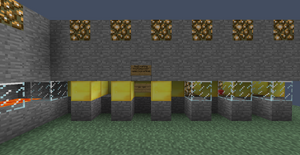
Игровой автомат типа «Слот-машина».
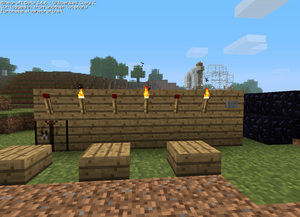
Простой игровой автомат.
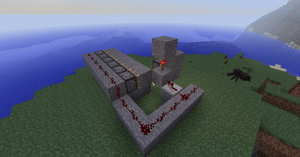
Автоматическая тростниковая ферма.
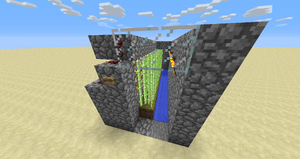
Полуавтоматическая тростниковая ферма.
Схема поддерживания сигнала
В качестве примера использования задержки рассмотрим поршневые двери:300px
В такой схеме нужно нажать на кнопку и успеть пробежать двери за одну секунду. Вместо этого между кнопкой и дверью можно установить схему задержки:
В такой схеме сигнал на выходе появляется практически сразу при подаче на вход, а исчезает спустя некоторое время после снятия входного. Каждые два повторителя представляют собой звено, которое может поддерживать сигнал до 0,4 с. Повторители, идущие в одну линию, настраиваются для достижения нужной длительности поддерживания сигнала, поперечные — в режиме минимальной задержки. Необходимо также помнить о правиле 15 клеток для выходной линии (той, что идет после поперечных повторителей).
Одноимпульсная кнопка
В некоторых случаях нужно сделать так, чтобы переключателем (например, кнопкой) можно было воспользоваться только один раз. Для этого можно воспользоваться комбинацией и :
Слева, на блоке красной шерсти, находится кнопка включения. Повторители нужны для определения предыдущего состояния триггера (два повторителя по 0,4 — 0,8 секунды назад). Без них система всегда будет считать, что нажатие уже произошло. Для сброса нужно прикрепить к нижнему блоку синей шерсти кнопку и активировать её.
Вариант проще без гейта (левая кнопка — вкл правая — сброс)
Sounds[]
Java Edition:
| Sound | Subtitles | Source | Description | Resource location | Translation key | Volume | Pitch | Attenuationdistance |
|---|---|---|---|---|---|---|---|---|
| Block broken | Blocks | Once the block has broken | 1.0 | 1.2 | 16 | |||
| None | Blocks | Falling on the block with fall damage | None | 0.5 | 1.25 | 16 | ||
| Block breaking | Blocks | While the block is in the process of being broken | 0.25 | 0.75 | 16 | |||
| Block placed | Blocks | When the block is placed | 1.0 | 1.2 | 16 | |||
| Footsteps | Blocks | Walking on the block | 0.15 | 1.5 | 16 |
- ↑
Bedrock Edition:
[needs in-game testing]
| Sound | Source | Description | Resource location | Volume | Pitch |
|---|---|---|---|---|---|
| ? | ? | Once the block has broken | ? | 1.2 | |
| ? | ? | Falling on the block with fall damage | ? | ? | |
| ? | ? | While the block is in the process of being broken | ? | 0.75 | |
| ? | ? | Jumping from the block | ? | ? | |
| ? | ? | Falling on the block without fall damage | ? | ? | |
| ? | ? | Walking on the block | ? | ? | |
| ? | ? | When the block is placed | ? | 1.2 |
Использование красной пыли
- Крафт: компас, часы, электрические рельсы, рельсы с датчиком, красный факел, нотный блок, раздатчик, выбрасыватель, повторитель, поршень, лампа
- Зельеварение: мирское зелье (усиленное), зелье огнестойкости (усиленное), зелье регенерации (усиленное), зелье силы (усиленное), зелье стремительности (усиленное), зелье ночного зрения (усиленное), зелье отравления (усиленное), зелье замедления (усиленное), зелье слабости (усиленное)
- «Провода» для механизмов
Рецепты крафта с красной пылью
| Название | Что нужно | Что получится | Описание |
|---|---|---|---|
| Компас | Слитки железа и красная пыль | Показывает на место спавна (точка появления игроков). | |
| Часы | Золотые слитки и красная пыль | Показывает положения солнца и луны (можно определить время суток). | |
| Электрические рельсы | Слитки золота, палки, красная пыль | Используются для ускорения или замедления тележек. | |
| Рельсы с датчиком | Слитки железа, каменная нажимная плита и красная пыль | Кнопка, которая активируется тележкой. | |
| Красный факел | Красная пыль и палка | Используется для передачи постоянного заряда или в качестве передатчика/ приемника при подключении к блоку. Может использоваться как освещение. | |
| Нотный блок | Доски и красная пыль | Позволяет создать музыку. | |
| Раздатчик | Булыжник, красная пыль и лук | Выбрасывает предметы в случайном порядке. | |
| Выбрасыватель | Булыжник, красная пыль | Выбрасывает предметы как при нажатии на клавишу «Q». | |
| Повторитель | Камень, красная пыль и факел из редстоуна | Используется в качестве ретранслятора и диода. | |
| Поршень | Булыжник, красная пыль, доски и железный слиток | Толкает блоки. | |
| Лампа | Красная пыль + Светящийся камень | Такую лампу можно включать и выключать с помощью красной пыли и рычагов. |
Рецепты зелий с красной пылью
| Название | Ингредиенты | Рецепт | Эффект |
|---|---|---|---|
| Мирское зелье (усиленное) | Красная пыль +Пузырёк воды | Нет | |
| Зелье огнестойкости (усиленное) | Красная пыль + Зелье огнестойкости | Иммунитет к огню и лаве на 8 минут | |
| Зелье регенерации (усиленное) | Красная пыль +Зелье регенерации | Восстанавливает здоровье игрока 2 минуты | |
| Зелье силы (усиленное) | Красная пыль +Зелье силы | +130% урона на 8 минут | |
|
Зелье стремительности (усиленное) |
Красная пыль +Зелье стремительности | +20% скорости на 8 минут | |
| Зелье ночного зрения (усиленное) | Красная пыль +Зелье ночного зрения | Ночное зрение на 8 минут | |
| Зелье отравления (усиленное) | Красная пыль +Зелье отравления | Уменьшает здоровье игрока, пока у него не останется 0,5 единицы здоровья, действует 2 минуты | |
| Зелье замедления (усиленное) | Красная пыль +Зелье замедления | -15% скорости на 4 минуты | |
| Зелье слабости (усиленное) | Красная пыль +Зелье слабости | -50% урона на 4 минуты |
History[]
| Notch claimed that «lamps» had actually stood for «Light A-givin’ Material Portal Side… the yellow stone thing». | |||||
| Java Edition | |||||
|---|---|---|---|---|---|
| 1.2.1 | 12w07a | Added redstone lamps. | |||
| 1.2 | The texture of redstone lamps has now been darkened, and the texture of lit redstone lamps has been slightly changed. | ||||
| 1.2.4 | release | A 2-tick delay to deactivation has been added to redstone lamps. | |||
| ? | Levers can be placed on redstone lamps. | ||||
| Jasper Boerstra tweets an image of updated redstone lamp textures. | |||||
| 1.13 | 17w47a | The different block IDs for the redstone lamp has now been merged into one ID. | |||
| A lit block state has been added to redstone lamps. | |||||
| Prior to The Flattening, these blocks’ numeral IDs were 123 and 124. | |||||
| 1.14 | 18w43a | The texture of redstone lamps has now been changed. | |||
| Pocket Edition Alpha | |||||
| v0.13.0 | build 1 | Added redstone lamps. | |||
| Bedrock Edition | |||||
| ? | Levers can be placed on redstone lamps. | ||||
| 1.10.0 | beta 1.10.0.3 | The texture of redstone lamps has now been changed. | |||
| Legacy Console Edition | |||||
| TU12 | CU1 | Patch 1 | 1.0.1 | Added redstone lamps. | |
| PlayStation 4 Edition | |||||
| 1.90 | The texture of redstone lamps has now been changed. | ||||
| New Nintendo 3DS Edition | |||||
| 0.1.0 | Added redstone lamps. |
Lit redstone lamp «item»
- The following content is transcluded from Technical blocks/Lit Redstone Lamp.
| Java Edition | ||
|---|---|---|
| 1.2.1 | 12w07a | Lit redstone lamps have an item form corresponding to its block ID. It can be obtained via inventory editors with numeric item ID 124. |
| Interestingly, unlike most items of this type, lit redstone lamps are themselves dropped by lit redstone lamps. | ||
| Pick Block on a lit redstone lamp block would highlight any existing lit redstone lamp blocks in the hotbar, rather than normal redstone lamps. | ||
| 1.2.4 | release | Lit redstone lamps now drop normal redstone lamp items when broken in most cases. They can still be obtained by breaking one with a Silk Touch enchanted tool. |
| 1.2.5 | pre | Pick Block on a lit redstone lamp will now always return a normal, unpowered redstone lamp. |
| 1.3.1 | 12w16a | Lit redstone lamp items can now be obtained in singleplayer worlds via the command using the respective numeric ID. |
| 1.7.2 | 13w37a | The direct item form of lit redstone lamps has been removed from the game. It can no longer exist as an item in any way, only as a placed block. |
| The ability for lit redstone lamps to drop lit redstone lamp items via Silk Touch has not been removed, however. As a result, attempting to obtain a lit redstone lamp this way in this version crashes the game with a . | ||
| 13w38a | Lit redstone lamp blocks now drop unlit items regardless of tool.[verify] | |
| Bedrock Edition | ||
| ? | Lit redstone lamps probably exist as an item. |
Appearances
| Java Edition | ||
|---|---|---|
| 1.2.1 | 12w07a | The lit redstone lamp item uses this model in inventories, when held in first or third person view or as a dropped item. |
| 1.2 | The lit redstone lamp item uses this model in inventories, when held in first or third person view or as a dropped item. | |
| This is due to the redstone lamp texture changing in this version. | ||
| 1.3.1 | 12w22a | The lit redstone lamp item now uses this model in inventories, when held in first or third person view or as a dropped item. |
| This is a result of all 3D items being rotated 90 degrees anticlockwise from their prior appearances. | ||
| 1.4.2 | 12w34a | The lit redstone lamp item now uses this model in inventories, when held in first or third person view, as a dropped item or when in an item frame. |
| This is a result of all 3D items being brightened to a miniscule degree. |
Історія
| Java Edition Alpha | ||
|---|---|---|
| 1.0.1 | Додано «Пил червоної руди» (предмет) і редстоун пил (блок) | |
| 1.0.2_01 | Редстоун пил тепер не підключається через тверді блоки по діагоналі вниз | |
| 1.0.4 | Перейменовано на «Редстоун». | |
| Java Edition Beta | ||
| 1.3 | Чим далі редстоун пил від джерела енергії тим темнішим він стає. | |
| 1.5 | Редстоун пил може бути розміщено на снігу. | |
| 1.6.6 | Змінено матеріал світлокаменю з «скло» на «камінь», що дозволило розміщати редстоун пил на нього. | |
| 1.7 | Redstone dust now will connect to a repeater without the dust being explicitly pointed at it. | |
| Крім вогню редстоун тепер єдиний спосіб активувати динаміт. | ||
| 1.7.3 | Pistons connected to the end of a piston transistor via redstone are now properly closed when the power goes out. | |
| Java Edition | ||
| 1.0.0 | Beta 1.9-pre1 | Снігопад тепер може знищувати редстоун пил. |
| 1.0.0-RC1 | Змінено вигляд одиночного редстоун пилу з «+» на «•». | |
| 1.1 | Хвіртку тепер можна відкривати за допомогою редстоун пилу. | |
| 1.3.1 | 12w21a | Редстоун тепер можна отримати за допомогою торгівлі. |
| 12w25a | Редстоун пил тепер можна розмістити на верхній частині перевернутих плит і сходів. | |
| 1.4.2 | 12w38a | Додано відьми. З них інколи випадає редстоун. |
| 1.5 | 13w01a | Редстоун використовується у крафті Блоку редстоуну і викидача. |
| 1.8 | 14w25a | Глюк «Безкінечний обсидіан» (дозволяв перетворювати Редстоун в обсидіан) виправляється в ході реалізації нового формату блоку метаданих |
| 0.8.0 | build 2 | Редстоун тепер випадає при видобутку руди редстоуну. |
| Legacy Console Edition | ||
| Додано редстоун. | ||
| Redstone dust now will connect to a repeater without the dust being explicitly pointed at it. |
Describing Circuits[]
Most circuits are described using Schematic diagrams; some of these require multiple images to show one or two layers per image. See the Help:Schematic page for details on how various blocks and components are represented.
Size
The wiki describes circuit size (the volume of the rectangular solid it occupies) with the notation of shorter width × longer width × height, including support/floor blocks, but not including inputs/outputs.
Another method used for describing circuit size in the Minecraft community is to ignore non-Redstone blocks simply used for support (for example, blocks under Redstone dust or repeaters). However, this method is unable to distinguish between and circuits, as well as some other circuit differences.
Sometimes it is convenient to compare circuits simply by the area of their footprint (e.g., 3×4 for a circuit three-block wide by four blocks long), or by a single dimension important in a particular context (e.g., length in a sequence of sub-circuits, height in a confined space, etc.).
Features
Several features may be considered desirable design goals:
- 1-high
- A structure is 1-high (aka «1-tall») if its vertical dimension is one block high (meaning it cannot have any redstone components that require support blocks below them, such as redstone dust or repeaters). Also see .
- 1-wide
- A structure is 1-wide if at least one of its horizontal dimensions is exactly one block wide.
- Flat
- A structure is flat if it generally can be laid out on the ground with no components above another (support blocks under redstone components are okay). Flat structures are often easier for beginners to understand and build, and fit nicely under floors or on top of roofs. Also see .
- Flush
- A structure is flush if it doesn’t extend beyond a flat wall, floor, or ceiling and can still provide utility to the other side, though redstone mechanisms may be visible in the wall. Flush is a desirable design goal for piston-extenders, piston doors, etc. Also see and .
- Hipster
- A structure is hipster if it is initially hidden behind a flat wall, floor, or ceiling and can still provide utility to the other side. See also and .
- Instant
- A structure is instant if its output responds immediately to its input (a circuit delay of 0 ticks).
- Seamless
- A structure is seamless if no redstone components are visible both before and after it completes its task (but it’s okay if some are visible during operation). Seamless is a desirable design goal for piston-extenders, piston doors, etc. See also and .
- Silent
- A structure is silent if it makes no noise (such as from piston movement, dispenser/dropper triggering when empty, etc.). Silent structures are desirable for traps or peaceful homes.
- Stackable
- A structure is stackable if it can be placed directly next to other copies of itself, and they all can be controlled as a single unit. Also see .
- Tileable
- A structure is tileable if it can be placed directly next to other copies of itself, and each copy can still be controlled independently. Also see .
- Structures might be described as «2-wide tileable» (tileable every two spaces in one dimension), or «2×4 tileable» (tileable in two directions), etc. Some structures might be described as «alternating tileable», meaning they can be placed next to each other if every other one is flipped or a slightly different design.
Other design goals may include reducing the delay a sub-circuit adds to a larger circuit, reducing the use of resource-expensive components (redstone, nether quartz, etc.), and re-arranging or redesigning a circuit to make it as small as possible.
Some components are not available before a player has access to the Nether, which limits the designs available. In particular, redstone comparators, observers and daylight detectors require nether quartz, which is available only from the Nether. Additionally, redstone lamps require glowstone, which is occasionally available from trading or witches, but is much more plentiful in the Nether.
JK flip-flops and latches[]
A JK flip-flop is another memory element which, like the D flip-flop, will only change its output state when triggered by a clock signal C. They can be edge-triggered (designs A, D, E) or level-triggered (C). Either way, the two inputs are called J and K. These names are arbitrary, and somewhat interchangeable: if a Q̅ output is available, swapping J and K will also swap Q and Q̅.
| J | K | Qnext |
|---|---|---|
| Q | ||
| 1 | ||
| 1 | 1 | |
| 1 | 1 | Q̅ |
When the flip-flop is triggered the effect on the output Q will depend on the values of the two inputs:
- If the input J = 1 and the input K = 0, the output Q = 1.
- When J = 0 and K = 1, the output Q = 0.
- If both J and K are 0, then the JK flip-flop maintains its previous state.
- If both are 1, the output will complement itself — i.e., if Q = 1 before the clock trigger, Q = 0 afterwards.
The table summarizes these states — note that Q(t) is the new state after the trigger, while Q(t-1) represents the state before the trigger.
The JK flip-flop’s complement function (when J and K are 1) is only meaningful with edge-triggered JK flip-flops, as it is an instantaneous trigger condition. With level-triggered flip-flops (e.g. design C), maintaining the clock signal at 1 for too long causes a race condition on the output. Although this race condition is not fast enough to cause the torches to burn out, it makes the complement function unreliable for level-triggered flip-flops.
The JK flip-flip is a «universal flip-flop», as it can be converted to any of the other types: It’s already an RS latch, with the «forbidden» input used for toggling. To make it a T flip flop, set J = K = T, and to make it a D flip-flop, set K to the inverse of J, that is J = K̅ = D. In the real world, mass production makes JK latches useful and common: a single circuit to produce in bulk, that can be used as any other sort of latch. In Minecraft, however, JK latches are generally larger and more complex than the other types, and using their toggle function is awkward. It’s almost always easier to build the specific latch type needed. Notably, an SRT Latch has all the same abilities, but gets the toggle function from a separate input.
Design E is a vertical JK Flip-Flop from the basis of design A.
Aside from these redstone designs, it is also possible to make a JK flip-flop by modifying a , or with newer components such as hoppers and droppers.
JK Latch A
View at: Redstone circuits/Memory/JK Latch A
JK Latch C
View at: Redstone circuits/Memory/JK Latch C
JK Latch D
View at: Redstone circuits/Memory/JK Latch D
JK Latch E
View at: Redstone circuits/Memory/JK Latch E
Design table
| Design | A | C | D | E |
|---|---|---|---|---|
| Size | 9×2×11 | 7×4×5 | 5×2×7 | 14×10×1 |
| Torches | 12 | 11 | 8 | 10 |
| Redstone | 30 | 23 | 16 | 24 |
| Repeaters | 6 | 6 | ||
| Accessible Q̅? | No | Yes | Yes | No |
| Trigger | Edge | Level | Edge | Edge |